




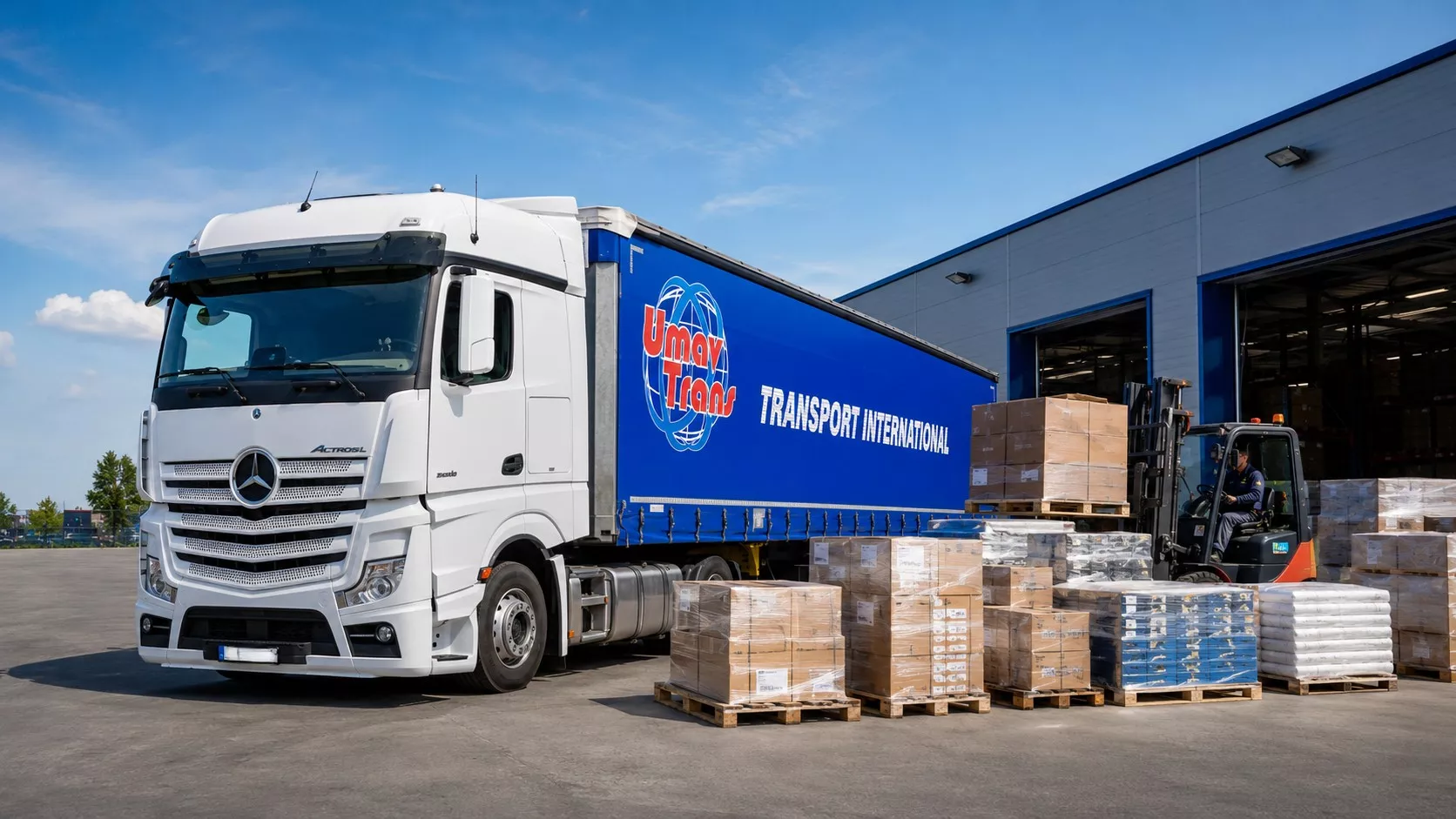
Palletised goods are one of the most widely used transport formats for companies importing or exporting products to and from Europe. Pallets simplify handling, warehousing, truck loading and inspection on delivery. However, a well-organised pallet shipment means more than simply putting boxes on a pallet and calling a truck.
For transport to be efficient, pallet dimensions, weight, volume, packaging, cargo securing, stackability, truck type, documents and the right solution—groupage, LTL or full truckload—must all be considered.
Umav Trans provides international road transport for palletised goods, with groupage, full truckload, warehousing, cargo consolidation and customs brokerage through its own customs brokers. The company’s main route is Moldova–Italy–Moldova.
Palletised goods are placed on pallets and prepared for handling with a pallet truck, forklift or other warehouse equipment. Instead of loading each box or parcel separately, the products are grouped into a more stable logistics unit.
This method is frequently used for:
For international transport, palletisation improves cargo control and reduces the risk of loss, mixing or incorrect handling.
In Europe, the most commonly used type is the 120 × 80 cm Euro pallet. Pallets measuring 120 × 100 cm are also frequently used for bulkier or industrial goods.
| Pallet type | Dimensions | Common use |
|---|---|---|
| Euro pallet / EPAL 1 | 120 × 80 cm | Trade, distribution, standard palletised goods |
| Industrial pallet / Euro 2 | 120 × 100 cm | Heavier or bulkier goods |
| Half pallet | 60 × 80 cm | Small lots, samples, small commercial deliveries |
| Special pallet | varies according to the goods | Equipment, non-standard products, special loads |
Companies shipping goods to or from Europe must communicate dimensions accurately. Even a small difference can affect the calculation of truck space, especially for groupage transport.
Capacity depends on the truck type, pallet dimensions, cargo height, weight and stackability. Reference values can be used for a quick estimate.
| Truck type | Euro pallets 120 × 80 cm | Approximate volume | Approximate payload |
| Standard curtain-side trailer | up to 33 pallets | approximately 82–90 m³ | up to 22–24 t |
| Tandem curtain-side truck | approximately 36–38 pallets | approximately 100–120 m³ | depending on the configuration |
| Van / small truck | 4–10 pallets | varies by model | varies by model |
These figures are indicative. Exact capacity must be confirmed for each shipment according to the available truck, pallet type, cargo weight and loading method.
On the Fleet page, Umav Trans can provide the exact capacities of its two main truck types separately: standard curtain-side trailer and tandem curtain-side truck.
The transport solution depends primarily on the number of pallets, volume, weight and required delivery time.
| Transport solution | When it is suitable | Approximate volume |
| Groupage | Small consignment, economical transport, consolidation with other loads | 1–4 pallets |
| LTL / partial load | Medium-sized consignment occupying a significant part of the truck | 5–25 pallets |
| Full truckload / FTL | Large load, dedicated truck | over 25 pallets |
| Standard curtain-side trailer | Large quantity of palletised goods | up to 33 pallets |
| Tandem curtain-side truck | Higher volume, loads requiring additional space | approximately 36–38 pallets |
For B2B customers, this choice is important. If you are shipping 2–3 pallets, booking a full truck usually makes little sense. If you have more than 25 pallets, a full truckload may be more efficient and easier to organise.
Groupage transport is suitable when the goods do not fill an entire truck. Pallets from several customers are grouped and transported along the same route.
This solution is suitable for:
The main advantage is that you pay for the space used rather than the entire truck. However, for groupage it is essential that the goods are properly packaged, labelled and palletised, because they may be handled several times during the logistics process.
Service details Groupage transport.
For 5–25 pallets, transport may fall into an intermediate category: it is neither a full load nor a very small groupage consignment. In such cases, the solution may be partial-load transport, LTL or a tailored logistics combination.
This option is suitable when:
For 5–25 pallets, weight, volume and height must be analysed carefully. Ten very tall or very heavy pallets may sometimes occupy more space than fifteen standard pallets.
A full truckload is suitable when the goods occupy most of the truck or when the customer needs a dedicated solution.
It is recommended for:
Advantages of a full truckload:
Service details Full truckload.
Weight is one of the most important factors in pallet transport. The gross weight of each pallet must be known—that is, goods + packaging + pallet.
Weight affects:
| Situation | Number of pallets | Total weight | Note |
| Light, bulky goods | 10 pallets | 1,500 kg | volume matters more |
| Heavy goods | 10 pallets | 9,000 kg | payload matters more |
| Standard goods | 10 pallets | 4,000 kg | volume + weight are assessed |
Two shipments with the same number of pallets may require different solutions and have different costs if their weight or volume differs.
Volume indicates how much space the goods occupy. In pallet transport, volume depends on length, width and height.
Basic formula:
Volume = length × width × height
For a 120 × 80 cm Euro pallet, volume depends greatly on the height of the load.
| Pallet dimensions | Cargo height | Approximate volume |
| 120 × 80 cm | 1.00 m | 0.96 m³ |
| 120 × 80 cm | 1.20 m | 1.15 m³ |
| 120 × 80 cm | 1.50 m | 1.44 m³ |
| 120 × 80 cm | 1.80 m | 1.73 m³ |
| 120 × 80 cm | 2.00 m | 1.92 m³ |
These calculations help the carrier estimate the space required in the truck. If the load is tall and the pallet cannot be stacked, the occupied space may matter much more than the weight.
A very important detail is whether the pallet can be stacked. If other goods can be placed on top, truck space can be used more efficiently. If the goods are non-stackable, the full vertical space must be reserved.
| Pallet type | What it means | Impact on transport |
| Stackable | other goods can be placed on top | uses space more efficiently |
| Non-stackable | nothing can be placed on top | occupies more truck space |
| Fragile | requires additional protection | may limit consolidation |
| Heavy | must be positioned correctly | affects weight distribution |
If the goods are non-stackable, this must be communicated from the outset. Otherwise, problems may arise during warehousing, consolidation or loading.
Correct packaging is essential in international transport. The goods must withstand handling, vibration, braking, loading, unloading and possible temporary storage.
Useful packaging materials:
Practical recommendation: stretch film should also be secured to the pallet base, not only wrapped around the boxes. If the film does not grip the base, the goods may slide off the pallet.
A common mistake is pyramid stacking or placing boxes beyond the pallet edges. This may seem acceptable in a warehouse but becomes risky during international transport.
| Correct | Avoid |
| boxes arranged in stable columns | pyramid stacking |
| weight distributed evenly | weight concentrated on one side |
| goods do not extend beyond the pallet | boxes protruding beyond the edges |
| film secured to the pallet base | film only around the upper section |
| labels on the sides | labels only on top |
Goods extending beyond the pallet edges are more easily damaged and may cause loading problems.
Labels help identify the goods quickly. They must be visible to the carrier, warehouse, customs broker and consignee.
Each pallet should display at least:
Labels should be placed on the sides, not only on top. A label placed only on top may become invisible when the pallet is stacked or stored.
For international transport, wooden pallets may require treatment in accordance with the ISPM 15 standard. This standard concerns wood packaging used in international trade and aims to reduce the risk of spreading pests.
In practice, treated pallets must carry a visible mark. If the pallet does not have the required marking, inspection or customs-clearance problems may arise depending on the country and operation.
Companies exporting or importing goods are advised to check pallets before loading.
The documents must match the actual goods. If the paperwork states eight pallets but ten are loaded, clarification and delays may result.
Documents that may be required:
| Information | Why it is important |
| number of pallets | for checking and loading |
| gross weight | for truck planning |
| net weight | for commercial documents |
| dimensions | for volume calculation |
| contents | for identifying the goods |
| invoice number | for cross-referencing commercial documents |
| country of origin | for customs brokerage and clearance |
For more details, see the article: Documents required for importing and exporting goods.
Palletised goods are well suited to warehousing and consolidation. If goods come from several suppliers, the pallets can be grouped in a warehouse and then transported together.
This solution is useful for:
For details: Warehousing.
Recommended article: Warehousing and goods consolidation for international transport.
The Moldova–Italy–Moldova route is one of Umav Trans’s main directions. For palletised goods, it is suitable for both groupage and full truckload transport.
The following can be organised on this route:
For details: Moldova – Italy – Moldova transport
| Detail | Situation |
| Number of pallets | 2 |
| Weight | 600 kg |
| Volume | 2.5 m³ |
| Likely solution | groupage |
| Note | suitable for consolidation with other goods |
| Detail | Situation |
| Number of pallets | 12 |
| Weight | 5,000 kg |
| Volume | 15 m³ |
| Likely solution | partial-load / LTL transport |
| Note | space, weight and deadline are assessed |
| Detail | Situation |
| Number of pallets | 33 |
| Weight | 20,000 kg |
| Volume | almost a full truck |
| Likely solution | full truckload |
| Note | suitable for a standard curtain-side trailer |
| Detail | Situation |
| Number of pallets | 26 |
| Weight | 4,000 kg |
| Volume | very high |
| Likely solution | full truckload or tandem truck |
| Note | volume may matter more than weight |
These examples are indicative. The final solution is determined after analysing the goods, route and available truck.
The most common problems arise from inaccurate information or inadequate packaging.
Mistakes to avoid:
Proper preparation before loading can prevent delays, additional costs and damage risks.
For an accurate quote, provide as much detail as possible about the goods.
| Information | Example |
| Loading country and city | Italy, Milan |
| Unloading country and city | Moldova, Chișinău |
| Number of pallets | 4 Euro pallets |
| Dimensions | 120 × 80 × 150 cm |
| Total weight | 1,200 kg |
| Are the goods stackable? | Yes / No |
| Type of goods | commercial products / parts / equipment |
| Available documents | invoice, packing list |
| Required date | approximate date |
| Required services | transport, warehousing, customs brokerage |
With these details, the Umav Trans team can recommend the right option more quickly: groupage, partial-load transport or full truckload.
Umav Trans provides solutions for international transport of palletised goods to and from Europe. Depending on the number of pallets, weight, volume and required date, the team can recommend groupage, partial-load transport, full truckload, warehousing or consolidation.
Available services:
Before the goods are collected, check the following:
If you have pallets to transport to or from Europe, the Umav Trans team can help you choose the right solution: groupage, partial-load transport, full truckload, warehousing, consolidation or customs brokerage.
Contact us and provide details about the goods, number of pallets, weight, volume, route and required date.